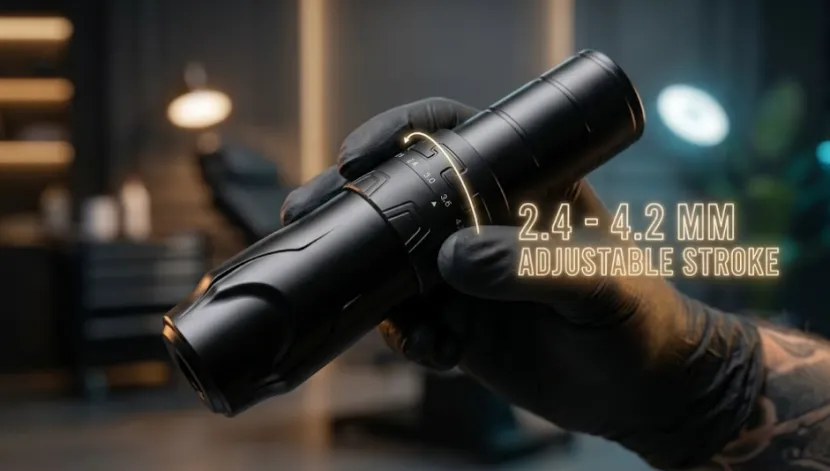
If you have ever looked at an adjustable stroke tattoo machine and thought, “Fine, but what do these numbers actually do,” you are not alone. Most artists do not struggle with the idea of stroke itself. The real problem is practical. You need to know the best tattoo machine stroke for lining, the best tattoo machine stroke for shading, and when a machine will start working against you instead of helping you. A small change in tattoo machine stroke length can affect hit, speed, ink flow, and how rough the skin feels after a pass.
What Is an Adjustable Stroke Tattoo Machine?
Before picking a number, it helps to keep one simple idea in mind. Stroke length is not a marketing detail. It changes the way the machine behaves in your hand and in the skin. That is why artists who do lining, soft black and grey, and color packing often end up wanting more than one setup. An adjustable stroke tattoo machine gives you a way to switch jobs without carrying three different pens.
What Tattoo Machine Stroke Length Really Means
Tattoo machine stroke length is the distance the mechanism travels in one full cycle. It is different from needle depth. That point matters because artists still mix up stroke length vs needle depth all the time. Stroke changes the machine’s hit and movement. Needle depth changes how far the needle hangs out. Those are related in use, but they are not the same thing.
Why This Matters When You Buy a Machine
On paper, stroke numbers look tiny. In a real session, they do not feel tiny at all. A short stroke tattoo machine moves fast and feels softer. A medium stroke tattoo machine feels more balanced. A long stroke tattoo machine hits harder and pushes larger groupings more easily, but it can also work the skin faster if your hand is too slow. That is the part many product pages skip, and honestly, it is the part most buyers actually care about.
A good example is INKONE, a tattoo equipment supplier established in 2018 in Yiwu. Its official company profile says the team handles custom service, product design, and independent software and hardware development, and also covers a wider product line that includes wireless tattoo machine models, needles, power supplies, and disposables. The same profile also highlights attention to production, inspection, packing, and delivery, plus 11 invention patents. Read as a buyer, that tells you the company is not only selling one pen. It is building around long term equipment supply and custom work, which matters if you care about consistency more than hype.
When Should You Use 2.4mm Stroke?
This is the setting many people underestimate. A 2.4mm stroke tattoo machine sits in the short range, and short stroke work is usually about softness, layering, and control rather than brute force. If your issue is smooth tones, not bold one pass lines, this is where things start making sense.
For Soft Black and Grey
A 2.4mm stroke tattoo machine is a short stroke tattoo machine, so it is a strong pick if you are chasing the best tattoo machine stroke for shading in soft black and grey. Shorter stroke machines let you build tone with more passes and less chewing on the skin. That makes them useful for smooth blends, soft whip shading, and gradual fades where you do not want the machine to slam pigment in too hard.
Where 2.4mm Starts to Struggle
Here is the tradeoff. A short stroke tattoo machine is not the best tattoo machine stroke for lining. It does not have the same push for strong lines, and if your needle hangs too far out, the machine may not retract enough to pick up ink well. That is when artists start seeing weak lines, patchy saturation, or that annoying feeling that the machine is running but the skin is not getting what it needs.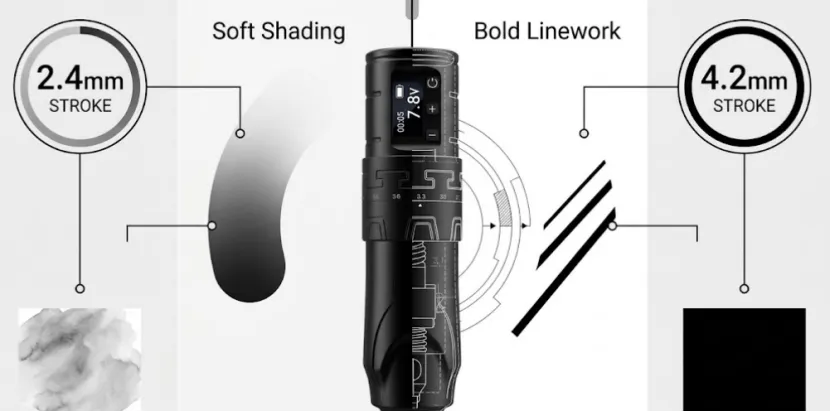
When Should You Use 3.0mm and 3.5mm Stroke?
This middle range is where most artists live day to day. It is not the softest option and not the hardest hitter either. That is exactly why it is popular. If you want a tattoo machine for lining and shading, medium stroke is usually the safest place to start.
Why a 3.0mm Stroke Tattoo Machine Feels Balanced
A 3.0mm stroke tattoo machine sits at the front of the medium stroke tattoo machine range. It is commonly used for blending, light shading, and smaller liners. If you switch styles during a session, this setting feels easier to manage because it gives you enough support without becoming too aggressive. For a lot of artists, 3.0mm is where an adjustable setup starts to feel genuinely useful instead of gimmicky.
Why a 3.5mm Stroke Tattoo Machine Is the Safe All Around Choice
A 3.5mm stroke tattoo machine is often treated as the do a bit of everything option. It is close to the standard medium range recommended for beginners and for artists who only want one machine on the tray. The reference guide even points to 3.5mm as the practical all round choice for lining, shading, and packing. On the adjustable stroke tattoo machine discussed here, the listed steps are 2.4, 2.7, 3.0, 3.3, 3.6, 3.9, and 4.2mm, so 3.6mm is the closest match to the classic 3.5mm feel.
When Should You Use 4.2mm Stroke?
Once you move into 4.0mm and above, the conversation changes. Now you are in long stroke territory, and that usually means more punch, more momentum, and less forgiveness if your hand speed is off. Good for some jobs. Not great for all of them.
For Bold Lines and Faster Packing
A 4.2mm stroke tattoo machine is a long stroke tattoo machine, and it is the clearest answer if you are looking for the best tattoo machine stroke for lining or the best tattoo machine stroke for color packing. Longer stroke lets the machine hit harder, carry more force into the skin, and handle larger needle groupings with less struggle. If you want crisp lines and solid fill, this is where the machine starts doing real heavy lifting.
Why 4.2mm Is Not Great for Smooth Shading
The same quality that helps with lines can become a problem in soft work. Long stroke is usually a bad fit for smooth blends because shading often needs repeated passes, and repeated passes with a hard hit can overwork the skin fast. It is one of those settings that feels amazing when it matches the job and slightly awful when it does not.
What Mistakes Do Artists Make With Stroke Length?
Most problems do not come from choosing a “bad” number. They come from using the wrong number for the task, or from expecting stroke to fix something that is really a hand speed, depth, or angle issue. That is why stroke discussions go in circles online. The number matters, but technique still decides a lot.
Stroke Length vs Needle Depth
The biggest mistake is still confusing stroke length vs needle depth. If you raise needle depth on a short stroke setup, the needle may not retract enough into the tip to grab ink well. That can leave you with weak lines and patchy color, even though the machine looks like it is running normally.
Angle, Ink Pickup, and Real Session Problems
There is another small detail that gets ignored. With very short stroke, machine angle matters more than people think. The reference guide notes that if you hold the pen at too much of a tilt, the needle may not reach ink properly in the tip. Holding it more vertically can help. It sounds minor. In practice, that tiny fix can save a frustrating afternoon.
How Should You Choose a Machine for Daily Work?
If your goal is daily versatility, you want enough range to move from soft work to firmer work without changing your whole setup. That is where internal structure, battery design, and included accessories matter, not just stroke numbers on a spec sheet.
A Practical Rule You Can Actually Use
Choose 2.4mm when your focus is smooth black and grey. Choose 3.0mm when you want a balanced feel for blending and lighter all around use. Choose 3.5mm, or 3.6mm on this model, when you want the safest one machine answer. Choose 4.2mm when lines and packing matter most. If you are comparing options, the tattoo machines section shows that this pen comes with a 2.4 to 4.2mm stroke range, two batteries, an RCA adapter, a 1500mAh battery, about 4 to 6 hours of working time, and 0 to 2 hours charging time. If your business also needs custom product development, the site lists an OEM/ODM service as part of its broader supply model.
FAQ
Q1: What is an adjustable stroke tattoo machine?
A: An adjustable stroke tattoo machine lets you change the stroke length so the same machine can handle softer shading, medium all around work, or harder hitting lining and packing.
Q2: What is the best tattoo machine stroke for lining?
A: In most cases, a longer setting such as 4.0mm or above is the best tattoo machine stroke for lining because it hits harder and handles larger groupings better.
Q3: What is the best tattoo machine stroke for shading?
A: For soft black and grey, a shorter setting such as 2.4mm is often the best tattoo machine stroke for shading. For blending with more versatility, 3.0mm also works well.
Q4: Is a 3.5mm stroke tattoo machine good for lining and shading?
A: Yes. A 3.5mm stroke tattoo machine is widely seen as the safest middle ground if you want one tattoo machine for lining and shading. On the model discussed here, 3.6mm is the nearest equivalent.
Q5: What is the difference between stroke length vs needle depth?
A: Stroke length is the travel distance of the mechanism in each cycle. Needle depth is how far the needle hangs out. They affect each other in practice, but they are not the same setting.