The tattoo industry is quiet these days.
Gone are the loud, buzzing coils. You know the ones. They used to dominate every shop floor. They created a loud, rattling noise. But things have changed. Technology has moved on.
Now, artists have tools that are lighter. They are consistent. They are far easier to handle.
But this shift brings a new problem. There are too many choices.
You have voltage specs. You have variable stroke lengths. You have battery packs. You have different motor types. There are endless brands fighting for attention. It gets confusing fast.
Maybe you want to retire your old coil setup. Or maybe you want to upgrade to a modern wireless rig. This tattoo machine guide cuts through the noise. You don’t need a degree in engineering to pick a machine. You just need to know how the specs affect your daily art.
In this guide, we will break down the mechanics. We will look at the comfort. We will look at the specific features. These are the things that separate a toy from a professional tool.
The Evolution: Why Rotary Pens Took Over
History respects the coil machine. It is the tool that built the modern tattoo industry. People love its soulful “hit.” They respect the skill required to tune it.
But the future belongs to the motor.
The shift happened for practical reasons. It was not just a trend. Coils are heavy. They are loud. They require constant tinkering. You have to mess with springs. You have to fix contact screws. You have to check capacitors.
Imagine this. A slight change in humidity happens. Or the power supply fluctuates. This could throw off a coil’s tuning. Then, the artist has to stop mid-session. That is a pain.
Why Professionals Switch
A rotary tattoo pen is different. It uses an electric motor. This motor drives the needle. It sounds simple. But the difference in your hand is massive.
You get a machine that weighs almost nothing. Compare that to a coil iron. Coils are heavy. They often weigh 250g or more. Rotary pens drop that down to 130g-0g.
This big drop in weight helps your wrist. It saves you from long-term damage. We are talking about things like Carpal Tunnel Syndrome. We are talking about chronic tendonitis. These injuries have ended many careers early.
Plus, the needle movement is consistent. The motor spins in a circle. A cam system turns that into a straight line. This makes sure the needle returns to the exact same spot. Every single time.
You don’t have to fight the machine to get a smooth line. You just focus on the skin. This “Plug and Play” nature is great. It allows artists to focus purely on creativity. You don’t have to worry about the mechanics.
If you are curious about the mechanics, you should read more. Look for articles on What is a rotary tattoo machine and why so many artists are switching to rotary tattoo pens.
Wired vs. Wireless: Freedom via Power
Power sources have changed a lot. They changed just as much as the machines themselves.
For years, you were tied to a wall. You had a clip cord. You had a heavy foot pedal. This setup was reliable. But it created a “leash.” It limited your movement.
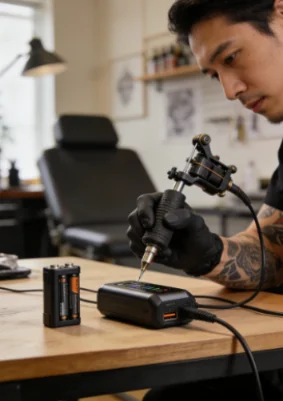
Now, battery technology is better. It has reached a point where it can handle an all-day session. It does not fade. It uses high-density Lithium-Ion cells. These provide stable voltage output.
The Case for Wireless
A wireless tattoo machine changes how you move. It changes how you work around the client. You no longer have a heavy RCA cord dragging across your station. You don’t have to worry about knocking over ink cups. You don’t get caught on the armrest.
You have 360-degree freedom.
This is critical for difficult spots. Think about ribs. Think about necks. Think about knees. You often need to twist your hand into awkward angles.
With a wired machine, the cord pulls against your hand. It fights your movement. With wireless, the center of gravity is in the pen. It stabilizes your hand.
Hygiene improves, too. Fewer cords mean fewer things to bag. It means fewer points for cross-contamination. Setup is faster. Breakdown is faster5. You aren’t fighting with cables.
For more details, check out Wireless Tattoo Machine vs. Wired Tattoo Machine.
Key Features Decoded: Stroke and Voltage
Don’t buy a machine just because it looks cool on Instagram. Don’t buy it because a famous person uses it.
The most critical spec is the stroke length. This defines the character of the machine. It tells you what style of tattooing it handles best.
The Importance of Stroke Length
Stroke length is simple. It is the distance the needle travels in one turn. It goes from all the way up to all the way down.
- Short Stroke (1.8mm – 2.5mm):This hits soft. It hits fast. It is great for smooth black and grey shading. It is good for realism. It is good for layering. You want to apply ink gently. You don’t want to cause trauma. It acts like a brush.
- Medium Stroke (3.5mm):This is the standard. It is a hybrid. It can do lines (with fine needles). It can also shade well.
- Long Stroke (4.0mm+):This hits hard. It is direct. It is essential for bold traditional lines. It pushes -liners or larger. It is good for packing solid color quickly. It acts like a hammer. It pushes ink deep with a single pass.
In the past, you needed different machines. You needed a “Liner.” You needed a “Shader.”
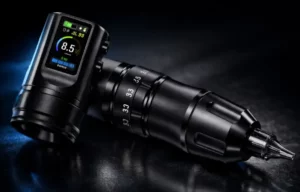
Today, an adjustable stroke tattoo machine solves that.
You just twist the grip. Or you turn a dial on the motor. You can change the geometry of the hit. It saves money. It keeps your setup minimal. You don’t have to swap machines mid-session. You don’t break your flow. You just adjust the stroke.
You can learn exactly how this works in this Adjustable stroke tattoo pen guide.
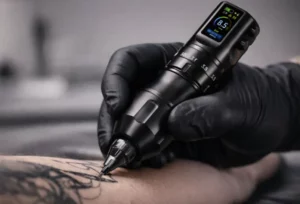
Comparative Analysis: Choosing Your Tool
Let’s look at the differences. We have broken down the key specs of modern machines:
| Feature | Standard Wired Pen | Fixed Stroke Wireless | Adjustable Stroke Wireless (2026 Trend) |
| Mobility | Low (Tethered by cord) | High (Battery powered) | Maximum (Battery + Multi-use) |
| Stroke Versatility | None (Fixed 3.5mm usually) | None (Must buy multiple machines) | High (2.4mm – 4.2mm adjustable) |
| Weight Balance | Rear-heavy (due to cord drag) | Top-heavy (battery weight) | Centered (Optimized ergonomics) |
| Setup Time | Slow (Cord bagging required) | Fast | Fastest |
| Cost Efficiency | Low (Need power supply + cords) | Medium | High (All-in-one solution) |
| Best For | Studio Workstations | Specific Styles (e.g., only Realism) | Traveling Artists & All-rounders |
Buying Guide: Matching the Machine to Your Style
This is the most common question. “What is the best tattoo machine for lining and shading?”
The truth is simple. There is no single “magic wand.” But there are versatile options. They get very close.
What to Look For
Maybe you do Realism on Tuesday. Then you do Traditional work on Friday. You need a workhorse.
Look for a machine with a medium-to-long stroke. Look for around 3.5mm to 4.0mm. This is the “sweet spot.” It is punchy enough to push a -liner. But you can dial it down. You use voltage to make it soft for shading.
Key factors to consider:
- Battery Life:A good wireless tattoo machine should last a long time. It should handle at least 5-6 hours of work. Look for machines with removable Built-in batteries are a risk. If the battery dies, the machine is useless. With removable batteries, you can swap them. You can keep working.
- Motor Type:Look for Brushless motors. They are better than Coreless motors in 202 They don’t get as hot. They last longer. They provide higher torque at lower voltages.
- Ergonomics:Comfort matters. If the grip is too thick (over 40mm), it hurts. If it is too thin (under 28mm), your hand cramps. Your lines will suffer after a few hours. The machine should feel like part of your hand.
For a step-by-step checklist, refer to How to choose the best wireless tattoo machine for daily work.
Machine Maintenance 101
You spend good money on your gear. So don’t treat it like trash. A rotary tattoo pen is tough. But it isn’t indestructible.
The #1 Killer: Ink Backflow
Ink backflow is the worst. If ink gets inside the motor, it is bad. It dries up inside the bearings. It ruins the mechanism. It causes the machine to freeze. Or it overheats.
Prevention: Always bag your machine completely. Use proper barrier film. Use quality membrane cartridges. The membrane stops fluid from leaking back into the grip. Avoid cheap cartridges. If they use simple rubber bands, don’t use them. They are not sealed.
Cleaning: Does your machine have a removable grip? If yes, autoclave it after every use. For the body, wipe it down. Use a medical-grade disinfectant. Use something like CaviCide. Do this after every single client. This is non-negotiable.
Battery Care: Keep the battery contacts clean. For a complete, step-by-step tutorial on disassembly and lubrication, read this dedicated guide: How to Keep Your Wireless Machine Running Forever.
Professional Equipment for Serious Artists
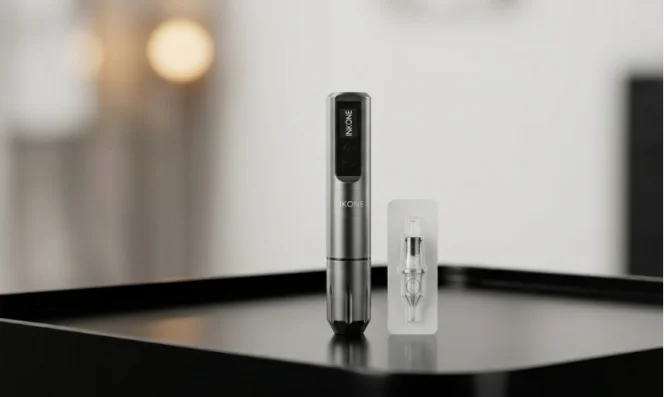
When you are ready, stop fighting your equipment. Start focusing on your art. Look at INKONE.
This isn’t just another generic brand. They don’t just slap a logo on a cheap motor. INKONE is a professional supplier. They are located in Yiwu city. They bridge the gap between high-end tech and fair prices.
Many brands are just “Trading Companies.” They buy generic machines. They add a markup. They resell them.
INKONE is different. They have a mature operating team. They know how to provide high-quality service. They were established in . They have rich experience in designing tattoo equipment.
The owner is good at developing circuit schemes. He is good at machine structures. Software and hardware can be developed independently by them.
You see this in their “One Wireless” series. It tackles the need for adjustable strokes. And it doesn’t have the crazy price tag of big-name brands.
The INKONE Difference:
- Build Quality:They pay attention to every detail, pursue perfection in production, and check quality carefully.
- Custom Motors:Their motors are custom-tuned. They give consistent torque at low voltages. This is essential for techniques like stippling. You need the machine to run slow. But it still needs to hit hard.
- Full Supply:They supply almost all tattoo equipment. They have wireless machines, cartridges, and power supplies.
- Safety:You are assured of safe and sterile equipment. This prevents health hazards to artists. It protects the customer too.
INKONE tests their gear. They don’t just test in a lab. It means when you pick up an INKONE machine, it feels right. The weight balance is good. The vibration is low. The power is stable. It is professional hardware. It is designed to work as hard as you do.
Conclusion
The switch from coil to wireless rotary pens is big. It is more than just a tech upgrade. It is a life improvement.
By 2026, the technology is ready. It is reliable. We worry less about if it will work.
The challenge now is choosing. You need a tool that matches your hand.
Maybe you like the freedom of wireless. Maybe you like the versatility of an adjustable stroke. Or maybe you like the comfort of a light pen. The right machine should feel like part of your body. It should disappear while you work. It leaves only you and your art.
FAQ
Q1: Can I use a rotary pen for lining?
A: Yes, absolutely. Old rotaries were weak. But a modern rotary tattoo pen is strong. If it has a 3.5mm or 4.0mm stroke, it has plenty of power. It can push bold lines. You just need to run it at a higher voltage. Usually, 8.5V to 9.5V is good.
Q2: How long do wireless batteries actually last?
A: It depends on how you use it. It depends on the voltage. If you run high voltage for lining, it drains faster. Expect about 4 to 6 hours. For soft shading, it uses less power. You might get more time. Always keep a spare battery charged. Then you never have to stop.
Q3: What is the best tattoo machine for lining and shading if I’m a beginner?
A: Get an adjustable stroke tattoo machine. It lets you experiment. You can try different “hits.” You can try soft vs. hard. You don’t have to buy five different machines. It is a training tool. It grows with you.
Q4: Do wireless machines vibrate more?
A: Actually, they usually vibrate less. A good wireless tattoo machine has the battery on top. This balances the weight. It acts as a counter-weight to the motor. This makes it feel smooth at the needle tip. It is better than a wired setup where the cord drags the back down.
Q5: Why is my machine getting hot?
A: You might be running the voltage too high. Or the cartridge membrane is too stiff. This makes the motor work too hard. Give the machine a break. If it gets hot instantly, there might be a motor issue.