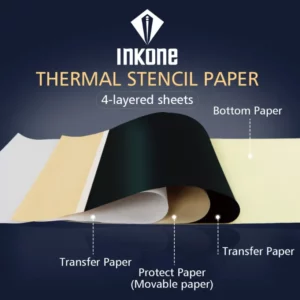
Thermal paper for tattoo stencils often looks straightforward. You run it through a thermal process, get a clean outline, and move on. In real studio workflows and bulk sourcing scenarios, the printed result is only the first signal. What matters more is whether the stencil keeps its shape and edges once skin prep, wiping, and machine behavior come into play. This article explains the most common issues seen with thermal tattoo stencil paper and what they usually indicate about transfer stability, not just surface appearance.
How Thermal Paper for Tattoo Stencils Responds to Heat and Pressure
Thermal paper for tattoo stencils relies on a coating that reacts within a narrow heat range. Heat activation alone does not determine clarity. Pressure consistency across the sheet plays a major role in keeping lines continuous and preventing small gaps that later turn into missing sections on skin.
Heat activation and coating sensitivity
A stable stencil comes from controlled coating response rather than maximum heat. When coating sensitivity varies, identical designs can produce different contrast levels. These differences often reappear later as uneven line clarity after wiping, especially in professional tattoo workflow conditions where speed and repetition matter.
Why pressure consistency matters more than peak temperature
High temperature can make lines look bold, but uneven pressure is a common cause of broken outlines. A stencil may appear fine on paper yet fail during transfer. For buyers, this signals that forgiving pressure response is more valuable than aggressive activation.
Blurry or Incomplete Stencil Prints: What This Tells You About the Paper
Blurry stencil lines and incomplete stencil transfer are often attributed to setup issues, but material behavior is frequently the real cause. Uneven coating release or unstable base layers can produce outlines that degrade quickly once applied to skin.
If these print issues also lead to outlines breaking down during wiping, the mechanism is closely related to why a tattoo transfer fades or smudges during early stages of tattooing.
Coating release inconsistency
When coating release is inconsistent, stencil edges lose definition. Some sections may look sharp while others appear dusty or fuzzy. That fuzziness tends to turn into line spread once the stencil is exposed to moisture or cleaning solutions.
Base sheet thickness and heat transfer
Base sheet thickness affects how evenly heat moves through the paper. Very thin sheets react quickly but can exaggerate small heat variations. Thicker bases may stabilize heat transfer, but only if coating uniformity is well controlled. In bulk sourcing, consistency across batches matters more than absolute thickness.
Overly Dark or Burned Stencils and Their Impact on Transfer Accuracy
Dark stencil prints are not always a positive sign. Overly dense results often come from excessive carbon transfer rather than controlled coating response. This can reduce transfer accuracy by softening line edges.
Excessive carbon transfer and line spread
Heavy carbon transfer may hide gaps on paper, but it often increases stencil line spread on skin. During wiping, these lines blur faster and lose definition, especially in fine details.
Stability during lining and wiping
A stencil that fades unevenly during the first few wipes forces artists to reconstruct outlines mentally. In professional environments, that instability translates into lost time and higher error risk.
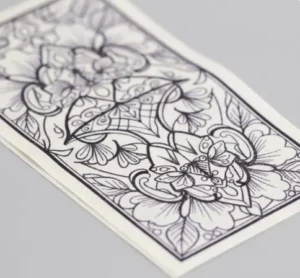
Paper Jams, Wrinkles, and Skewed Prints: A Material Perspective
Issues such as stencil paper wrinkles, skewed prints, and inconsistent feeding are often material-related. Paper flatness and humidity sensitivity affect how evenly heat and pressure are applied across the sheet.
Flatness, curl memory, and humidity response
Paper with strong curl memory reacts poorly to humidity changes. Minor waves in the sheet alter contact pressure, leading to uneven density that shows up later during transfer.
Why this matters in professional workflows
In high-throughput studios or production environments, small material inconsistencies multiply. Repeatability becomes more important than one-time print quality.
How Tattoo Machine Behavior Can Amplify Thermal Paper Issues
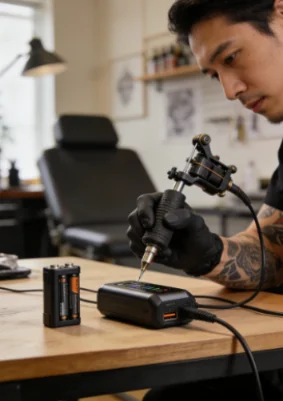
Once a stencil is on skin, tattoo machine behavior can magnify material weaknesses. Tattoo machine voltage stability affects needle movement consistency and the friction applied during early passes.
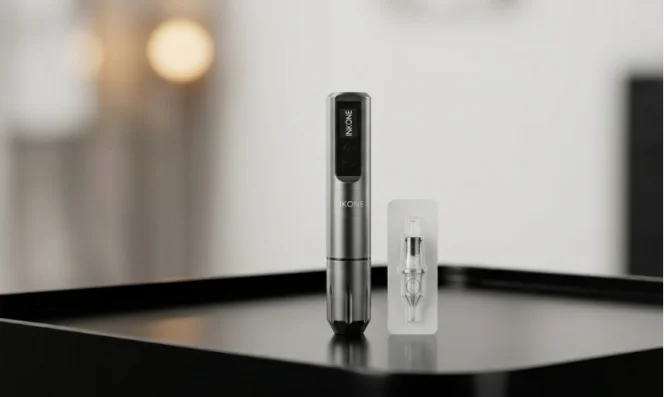
In professional setups, platforms such as the INKONE tattoo machine series are designed to minimize voltage fluctuation under load, helping reduce stencil line breakdown caused by uneven pressure.
Voltage stability and stencil line retention
Voltage fluctuation changes rhythm and pressure, which accelerates stencil degradation. Stable output supports stencil line retention during the first critical passes. This is why wireless tattoo machine stability is a practical consideration, not just a specification.
Machine vibration and edge degradation
Machine vibration introduces micro-movements that roughen stencil edges over time. Designs with reinforced internal structures, such as the INKONE Armor, tend to generate less micro-vibration during continuous operation, helping preserve edge clarity when thermal paper is sensitive.
What Buyers Should Evaluate When Sourcing Thermal Paper for Tattoo Stencils
Sourcing thermal paper should focus on long-term performance rather than single-sheet appearance. Before committing to a bulk purchase, evaluate repeatability and durability under real working conditions.
What to test before bulk purchasing
Check fine-line continuity, density uniformity, and edge clarity after standard wiping. Also confirm that results remain consistent after storage, especially in environments with humidity variation. For a broader evaluation framework, this guide on choosing the right transfer paper for tattoos provides a structured comparison approach.
When thermal paper is the right choice—and when it isn’t
Thermal paper is ideal when speed, repeatability, and clean outlines are priorities. It may be less suitable in environments with extreme variability or aggressive wiping routines. The right choice is the one that reduces rework and maintains consistency.
Conclusion
Thermal paper for tattoo stencils should be evaluated as part of a complete system. Printing symptoms reveal how the coating reacts, how the base sheet manages heat, and how machine behavior affects stencil line retention. Understanding these relationships helps buyers select materials that remain stable in professional use, not just on the first print.
INKONE Tattoo Equipment: Engineering-Focused Solutions for Professional Studios
INKONE is a professional tattoo equipment supplier specializing in wireless tattoo machines and related tattoo solutions. With in-house capabilities covering circuit design, mechanical structure, and integrated hardware and software development, INKONE focuses on building equipment that delivers stable output and consistent performance in real working environments. Beyond machines, INKONE also supplies essential tattoo consumables and accessories, supporting artists, studios, and distributors with products designed for reliability, safety, and long-term professional use.
FAQ
Q1: Does darker thermal stencil paper always transfer better?
A: Not necessarily. Excessive carbon density can cause line spread and reduce edge accuracy during wiping.
Q2: Why do some thermal stencils look fine on paper but fail on skin?
A: Uneven coating release or pressure sensitivity often causes outlines to degrade once moisture and friction are introduced.
Q3: How does machine voltage affect stencil durability?
A: Voltage instability changes needle rhythm and pressure, which can accelerate stencil breakdown during early passes.
Q4: Is thermal paper always the best option for professional studios?
A: Thermal paper works well for repeatable, high-speed workflows, but its suitability depends on environment and wiping intensity.
Q5: What should buyers test before ordering thermal paper in bulk?
A: Buyers should test batch consistency, fine-line retention, wiping durability, and performance after storage under realistic conditions.