
What Is a Tattoo Cartridge Needle?
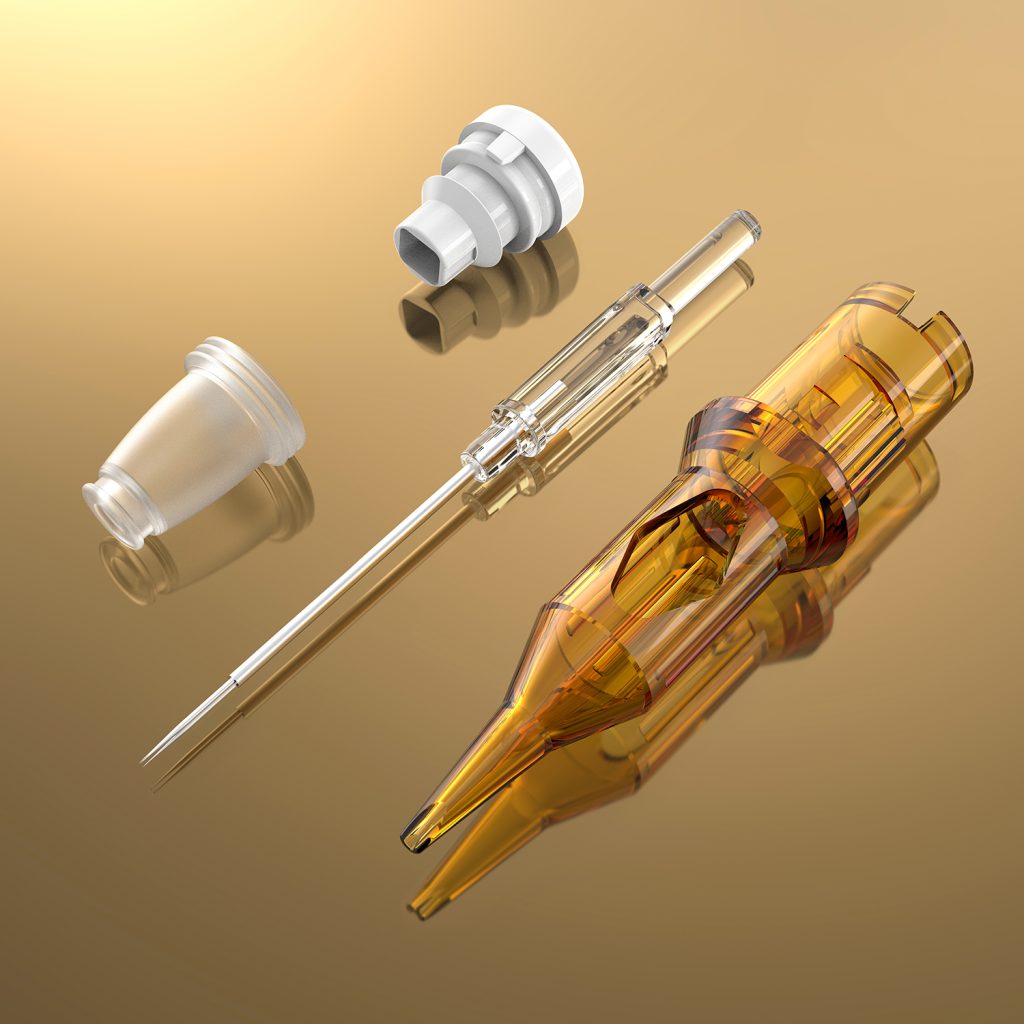
A tattoo cartridge needle is a single-use needle module in which a needle grouping, a plastic shell, a needle bar and a flexible membrane are enclosed in one unit that fits a rotary or pen-style tattoo machine.

Tattoo Cartridge Needle Groupings and Models
Groupings at a Glance
|
Model |
Grouping |
Work it is chosen for |
|---|---|---|
|
RL |
round liner |
fine lines, lettering and outlines |
|
RS |
round shader |
light shading and smooth transitions |
|
RM |
round magnum or curved magnum |
blending and smooth shading |
|
M1 |
magnum |
colour packing and large areas |
|
Bugpin |
smaller-diameter grouping |
realism, fine gradients and detailed texture |
Needle Diameters in the GT-R Range
#4 — 0.18 mm
#6 — 0.20 mm
#8 — 0.25 mm
#10 — 0.30 mm
#12 — 0.35 mm
Tattoo Cartridge Needles for Lining
Round Liner Groupings
For lining work the needle module by convention contains a single needle. Lining work, however, is not confined to 1G1 needles. Only when the artist is executing fine work such as lettering and tattoo art in the sensitive part of the hand can a 1G1 or 1RL needle be pragmatic. For regular line, as for instance the outline of a stencil, 1RL needles are impractical, because the skin can tear. But most of lining work is executed with 3RL (or 3G3) needles, both of them for the same reasons that justify the use of a single needle for lettering. The artist will practise with and without using a stencil and he will learn that the 3RL needle is more ergonomic than the 1RL needle. When operating without a stencil, a tattoo machine with a 1RL needle in it is barely controllable.
Cartridge Needles for Lettering and Script
Diameter Choices for Lettering
The GT-R range includes the RL round liner, the RM round magnum, the RS round shader and the M1 magnum, in diameters of 0.18 mm, 0.2 mm, 0.25 mm, 0.30 mm and 0.35 mm. For work of very fine width an 0.18 or 0.20 cartridge may be used.
Cartridge Needles for Shading and Blending
Long Taper and Medium Taper Compared
|
Feature |
Long taper |
Medium taper |
|---|---|---|
|
Point geometry |
longer, gradual narrowing |
shorter narrowing |
|
Typical preference |
fine detail and soft transitions |
bold lines and solid saturation |
|
Common applications |
lettering and black-and-grey realism |
traditional outlines and colour packing |
|
Main consideration |
reaching the desired saturation |
controlling edges and application |
Round Shader and Magnum Groupings
The RL round liner, the RS round shader and the M1 magnum are for shading. The range of the RS round shader covers shading as well as some filling, but the advantage of the RS over the M1 is that the RS is more stable. Strictly speaking, an RS is a fine magnum. The needle row of an RS is shallower than that of the M1, so that the forming of a shading layer by means of an RS is slower than by means of an M1. So the needle row of an RS is better suited for shading than for filling.
The M1 magnum is for very fine shading and in experienced hands even for lettering.
The M1 and the RS both have much overlapping of the surface layers when the artist is moving the machine across the skin.
Cartridge Needles for Colour Packing and Filling
Magnum Groupings for Fill
Filling is done with an M2 stable magnum or a scattered magnum, and also, although less commonly, with a 2RL or a 3RL round liner. In filling the artist packs colour in the skin by means of short vertical movements of the needle. Instruments in which the needle row is formed into a convex curve are the best for filling. For filling in a single colour an M2 stable magnum is the best. When the artist is filling in several colours and wishes to avoid confusion between colours, he uses a scattered magnum.
Cartridge Needles for Fine Detail and Realism
Bugpin Groupings
A bugpin grouping uses the smaller diameters of the range. Cartridge needles are single-use and disposable. All cartridges should be disposed of in a sharps bin. Cartridges should not be used for work other than on human skin, and must not be stored for future use on the human skin. The exact method of disposal is a matter of local regulation.
Common Faults in Tattoo Cartridge Needles
Faults seen in the field include wobble from a loose stabiliser, resistance from a badly seated membrane, poor ink flow from a misaligned tip and a leak beyond the barrier from a torn membrane.
Manufacturers’ test parameters are pressure, pull, leak and insert force.
Pressure, pull and leak are standard parameters that form the basis of the tester’s work.
For a Rotary Pen Type Machine the insert force is at the point where the needle bar is coupled to the needle module. For a Pen Style Machine the insert force is at the point where the needle module is coupled to the pen holder.
How to Test a Cartridge Sample
Baseline Inspection
A sample test compares startup, needle extension, return consistency, sound and vibration at the studio’s normal operating range. A needle-sample made up of new boxed cartridges and an equal number of cartridges that had been used at the studio for a period consistent with their maker’s specification, will disclose a drift in performance that can be correlated to the next purchase.
The first step is a baseline inspection under magnification of the sample. This is done in the presence of a second person and both signatures are recorded.
The baseline inspection records any bend in any needle, any irregularity of tip shape, any discrepancy in length between needles of a single module and any deviation of the needle-tip plane from the plane normal to the axis of the bar.
The record of a sample states the machine model, the grip, the cartridge code, the lot, the operating setting, the tester and the observation.
Repeat Batches and Batch Consistency
A repeat batch is a new lot of the needle modules from the same maker and of the same specification as the lot used at the studio. The lot is tested in the same manner as the sample and the difference in performance is reasoned out.
A negative result, that is, a performance inferior to that of the sample, calls for a complaint to the manufacturer.
A positive result, that is, a performance better than that of the sample, calls for a note to the effect that the maker has improved his product.
The measurements of a set of repeat batches over a period will reveal any deterioration or any improvement of the maker’s process. Such measurements are recorded in a log book together with the dates of the measurements.
INKONE Tattoo Cartridge Needles
INKONE was founded in 2018 at Yiwu, Zhejiang, China, and makes tattoo machines and tattoo cartridge needles for studios, distributors and private-label brands. OEM and ODM work covers custom packaging, logo printing and sample approval, and the GT-R range is supplied to distributors and private-label brands.