Choosing the right tattoo needle is one of those small decisions that completely change how a tattoo looks and feels. The proper setup doesn’t just control ink flow or line sharpness. It also decides how comfortably and efficiently you can bring a design to life. Every tattoo style, from delicate realism to bold traditional work, depends on grasping needle size, tattoo line thickness, and the link between technique and equipment.
The Role of Needles in Tattooing
Tattoo needles connect your artistic vision to the client’s skin. They control how much ink enters the dermis. This affects both saturation and line clarity. Fine liner groupings deliver crisp outlines. Larger shader or magnum setups spread pigment smoothly for gradients or fills. Picking the right needle boosts artistic results and client comfort. Every professional aims for that.
Different techniques call for specific configurations to achieve precision. For instance, stippling or dotwork works well with tight liners that offer controlled ink release. Soft shading, on the other hand, relies on curved magnums that glide easily over the surface.
Key Needle Components and Terminology
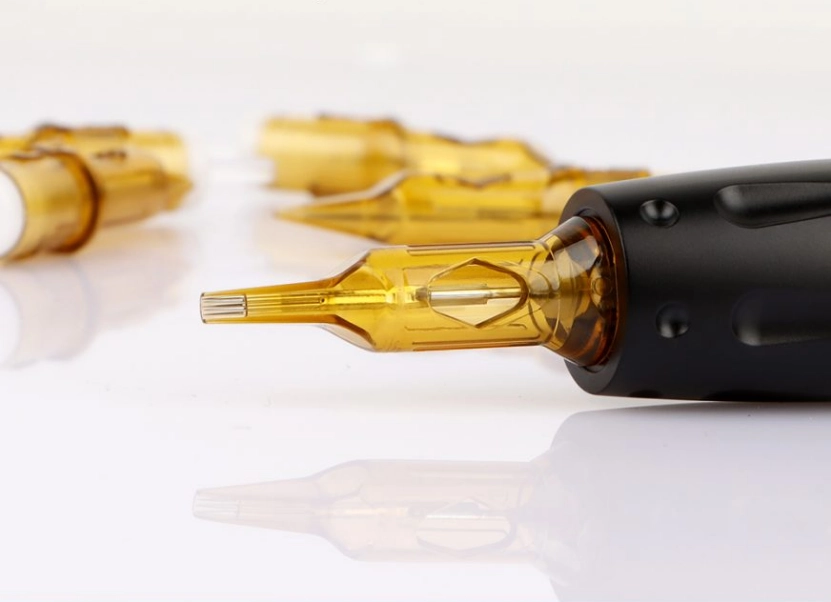
Every tattoo needle has three main aspects: diameter, taper, and configuration.
- Diameter: This sets the width of each individual needle point. It directly influences ink distribution and line thickness.
- Taper: The taper shows how long the needle’s point is before it reaches its full diameter. Short tapers put down more ink fast. Long tapers allow for finer detail.
- Configuration: This tells how multiple needles are grouped—liners (RL), shaders (RS), or magnums (M1/CM). Each grouping impacts coverage area and texture.
Grasping these terms lets artists make smart choices. You avoid relying on trial and error.
Exploring Common Tattoo Needle Types
Each type of needle serves a clear purpose in tattooing. You ensure consistency across styles when you know when to use which one.
Liner Needles
Liners focus on outlining and fine details. Smaller groupings like 3RL or 5RL create delicate lines. These suit script or micro tattoos. Larger ones such as 9RL produce bold outlines. You see them in traditional work.
| Common Liner Sizes | Typical Use Case |
| 1RL–3RL | Fine lines, micro-realism |
| 5RL–7RL | Medium outlines |
| 9RL–14RL | Bold traditional lines |
The tighter the grouping, the cleaner your outline looks. This matters most when you work on small lettering or facial features in portrait tattoos.
Shader Needles
Shader needles manage filling and blending tasks. Tattooists group them in round (RS) or flat formations to distribute pigment evenly across bigger areas. Round shaders often handle soft black-and-gray gradients. Flats shine at solid color packing.
Smooth transitions hinge on steady hand speed and angle control with shaders. Too much pressure can lead to patchiness or blowouts.
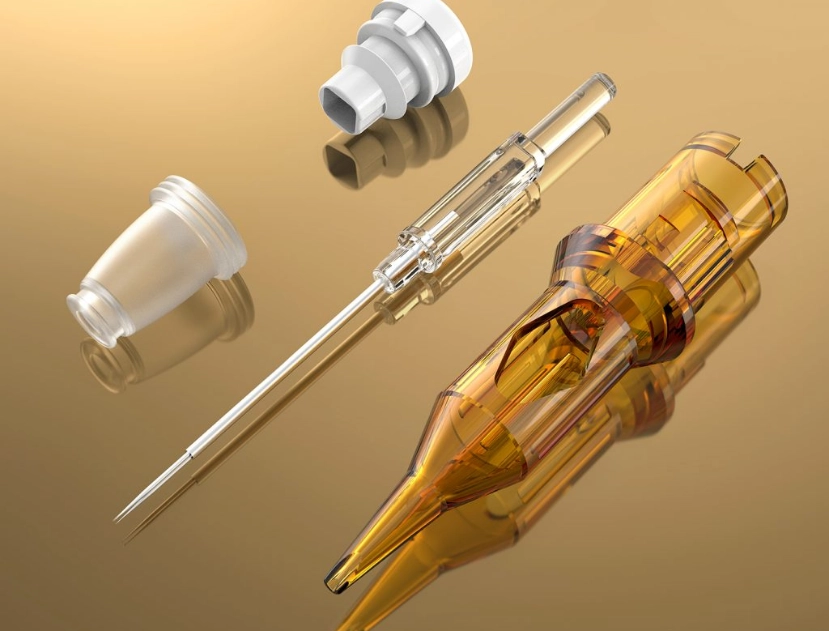
Magnum Needles
Magnums have two stacked rows of needles for wider coverage. They fit large-scale shading, coloring, and smooth blending techniques. Variants include:
- Standard Magnums (M1): Great for general shading.
- Curved Magnums (CM): Offer smoother blends with less trauma. They curve along skin contours.
- Double Stack Magnums (M2): Provide dense pigment saturation quickly. They’re useful for heavy color packing.
Matching Needle Size to Tattoo Line Thickness
Once you get the types, matching needle size to tattoo line thickness feels straightforward. Diameter plays a big role here.
Understanding Needle Diameter Codes
Tattoo needles come labeled by diameter codes:
| Code | Diameter | Typical Use |
| #08 | 0.25mm | Ultra-fine detail work |
| #10 | 0.30mm | Standard lining |
| #12 | 0.35mm | Bold outlines |
Thinner diameters work perfectly for realism. Subtlety matters there. Thicker ones deliver bold impact lines that stay visible over time.
How Diameter Affects Line Appearance
Smaller diameters produce finer lines. These suit intricate designs like geometric patterns or realistic hair textures. Larger diameters create stronger visual contrast. That’s ideal in traditional tattoos where bold outlines define structure.
Artists often test within these ranges. They consider ink viscosity and skin type to get the desired effect. You avoid overworking an area this way.
Choosing Needles by Tattoo Style and Technique
Different tattoo styles demand unique mixes of taper length, grouping type, and diameter size.
Fine Line and Realism Tattoos
For realism or fine-line work, smaller liner needles such as 1RL–3RL with short tapers give unmatched precision. These let you build subtle gradients that mimic natural shadows. You avoid heavy saturation. This proves essential when replicating lifelike textures like skin pores or hair strands.
Traditional or Neo-Traditional Tattoos
Traditional styles depend on strong outlines. These hold color boundaries clearly over time. Medium-to-large liners (7RL–9RL) achieve this efficiently. For filling solid colors within those outlines, round shaders between 7RS–11RS keep even pigment flow. They also minimize trauma.
Blackwork and Geometric Tattoos
In blackwork or geometric pieces, uniform saturation is key. Larger groupings ensure consistency across wide areas. Flat configurations help maintain symmetry in repetitive patterns. They distribute ink evenly along straight edges. This becomes a must when you execute precise mandalas or symmetrical motifs.
Shading and Color Packing Techniques
Soft Shading Applications
Curved magnums (CM) glide naturally over contours. They provide smoother blends with reduced irritation. These fit soft gradients in portraits or floral designs. Transitions need to look seamless there.
Solid Color Filling
Standard magnums (M1) offer dense pigment application. They’re suitable for vibrant color blocks like Japanese backgrounds. Or illustrative designs that require even coverage across large spaces.
Factors to Consider When Selecting Tattoo Needles
Beyond style preference, several outside factors shape which needle performs best in a session.
Skin Type and Placement Area
Sensitive areas such as ribs or inner arms may need smaller groupings. These minimize irritation. Thicker skin zones like backs can handle larger configurations. They allow deeper penetration without excess trauma.
Machine Type Compatibility
Coil machines often pair better with larger groupings. Their power delivery suits heavier setups. Rotary machines provide more versatility. They handle both liners and magnums smoothly. This comes from consistent motor performance across varied resistance levels.
Ink Flow Control
Ink viscosity must match needle diameter for steady flow through the tube tip. If ink is too thick for a small-diameter setup, it may clog. Too thin in a wide grouping could oversaturate quickly. Adjusting dilution ratios helps. It maintains consistent deposit rates across different pigments.
Professional Tips for Artists Sourcing Quality Needles from INKONE
Reliable supplies make all the difference. You go from frustration mid-session to effortless execution from start to finish.
Why Choose INKONE as Your Tattoo Supply Partner
INKONE offers a full range of tattoo needle types. These suit all techniques and styles. They provide OEM/ODM customization services tailored to professional artists’ needs. Their catalog covers every configuration discussed. That includes fine liners to double-stack magnums. It ensures compatibility no matter your preferred machine setup or artistic approach.
Ensuring Consistency in Every Session
INKONE’s quality control guarantees uniform soldering, sterilization, and packaging standards. Their reliable supply chain ensures steady inventory for studios worldwide. That reliability means fewer interruptions during busy seasons. It’s a quiet but crucial advantage. You maintain workflow efficiency across multiple clients daily.
FAQs
Q1: What does “needle size” mean in tattooing?
It refers to the diameter of each individual pin within a grouping. Smaller sizes produce thinner lines while larger ones create bolder strokes.
Q2: Which needle should I use for fine-line tattoos?
A small liner such as 1RL–3RL works best. It offers precise control over detail without excessive ink flow.
Q3: Are curved magnum needles better than flat ones?
Curved magnums cause less skin trauma during shading. Their rounded edge follows body contours more naturally than flats do.
Q4: How do I know if my machine matches my needle setup?
Check voltage requirements. Coil machines handle heavier groupings better. Rotary types adapt easily between liners and shaders due to smoother motion output.
Q5: What affects line thickness besides needle size?
Hand speed, pressure depth, ink viscosity, and machine power all influence final line appearance alongside chosen diameter code (#08–#12).