
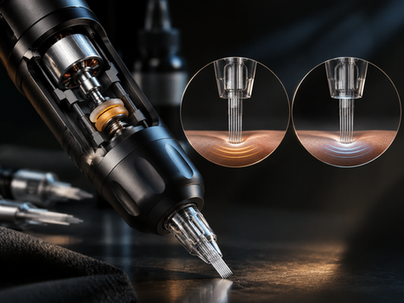
Tattoo machine give describes how the needle mechanism yields under resistance. As such it relates to the ‘hit’ of a tattoo machine. Give does not necessarily mean soft, as firm hits can be used in tattooing. Often however more give means a softer hit.
What Is Give in a Tattoo Machine?
Understanding the Meaning of Tattoo Machine Give
Give – This term describes how much yielding (or ‘give’) a spring or a cushioning structure gives under skin resistance. More cushioning does not always result in a better tattoo; it just gives a softer hit.
How Does Give Work in a Tattoo Machine?
Coil machines are driven by an electromagnetic field and springs, while rotaries are driven by motors and various drive mechanisms that may incorporate fixed or adjustable cushioning.
How Does Give Affect the Hit of a Tattoo Machine?
Understanding Tattoo Machine Hit
Hit describes how firm or yielding the tattooing feels as the needle penetrates into the skin. There is no universal numerical rating for comparing the hit of different machines.
The Relationship Between Give and Hit
More give generally feels softer than less give. However, there are limits to how soft or hard one can make a tattoo machine. Also, technique, amount of pressure and depth of tattooing play a big role in achieving the optimal result.
More Give vs. Less Give: What’s the Difference?
More Give – A Softer Hit
Some artists prefer machines with more cushioning, for gradual layering of black and grey and for very subtle shading between colors.
Less Give – A Harder Hit
While some artists use cushioning for gradually layered black and grey shading, others prefer more solid fills (of color) and often prefer a harder hit – with the aforementioned prerequisite of good hand control.
How Does Tattoo Machine Give Affect Different Tattooing Techniques?
Give for Lining
Important for lining: the needle must act as predicted. Compare tattoo machines with the grouping of needles you are used to. Many artists prefer low yielding.
Give for Shading
A tattoo machine with more give is often chosen for gradual shading, but this has to be matched with the artist’s hand speed and the needle type and configuration used.
Give for Color Packing
Color packing is often better served with a firmer hit – and here again you need to check the grouping and how the needle is moving before adding more pressure to ‘fill in’ patchy areas.
What Factors Determine the Amount of Give in a Tattoo Machine?
In order to assess the needle’s response, a machine’s design, springs, cushioning and drive have to be tested in combination with the membrane resistance of tattoo needle cartridges. All settings (voltage etc.) do not have the same effect on give.
Mechanical Give vs. Electronic Give (eGive): What’s the Difference?
Mechanical Give
This is the mechanical give provided by the springs or cushioning in a machine’s structure. Some of these designs are fixed, while others are adjustable.
Electronic Give (eGive)
Electronic give uses motor control to change the response when the needle meets resistance. On compatible systems, digital settings allow a softer or firmer hit without an adjustable mechanical cushion.
Which System Should Artists Choose?
A fixed design offers simplicity, whereas an adjustable design is more flexible. Neither is universally better; the choice depends on your preferences and techniques.
Tattoo Machine Give vs. Stroke Length, Torque, and Voltage
Give vs. Stroke Length
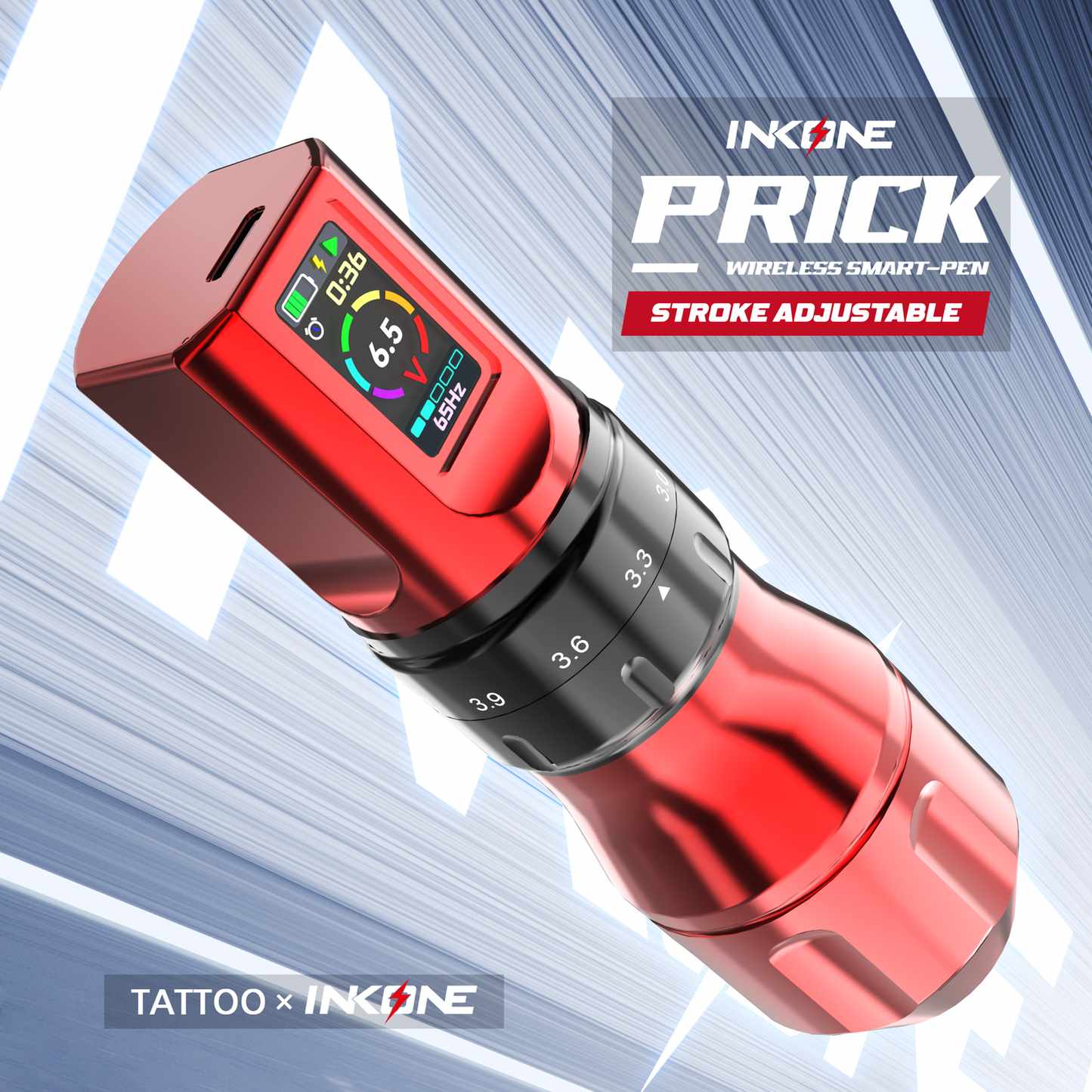
Stroke refers to the physical length the needle travels. Give describes yielding under resistance. The artist’s perception of the give in the stroke though, can vary greatly between similar strokes on different machines.
Give vs. Torque
Torque is the force with which the motor turns; this is in contrast to the ‘give’ of the cushioning. High torque does not necessarily mean a non-yielding response.
Give vs. Voltage
The voltage controls how fast the machine operates. But decreasing voltage does not add mechanical give to the mechanism. Compare motor and stroke configurations together.
How to Choose a Tattoo Machine with the Right Give
Match Give to Your Tattooing Style
To compare hard and soft and to judge whether a setting for harder hits can also be used for filling work, test your usual work of lining, shading and packing.
Consider Adjustable Give Features
Do controls change the give, the electronic response or the stroke length? Take note of the settings that you find useful and refer back to them in the future.
Evaluate Overall Machine Performance
Assess the machine’s drive, the motor stability, the overall vibration, how the machine sits in your hand, the stroke length and the fit of your standard cartridge. Keep cartridges consistent when comparing machines.
What Should Tattoo Equipment Buyers Look for in a Manufacturer?
Evaluate Product Design and Manufacturing Quality
What are the drive components like? Are the motors and structural components compatible with other components? What kind of testing has been done with the tattoo machines? How does the needle respond in different samples?
Explore OEM and ODM Customization
For OEM and ODM development specify the desired structure, performance, appearance, branding and packaging of the machine and request samples to confirm feasibility of the requested tattoo machine. Sourcing machines and matching consumables together can simplify ordering for distributors and private-label brands.
Conclusion: Find the Right Balance Between Give and Hit
Choose give that suits your technique and equipment. For professional tattoo supplies or OEM/ODM development, contact INKONE with your preferred machine response and purchasing requirements.
Frequently Asked Questions About Tattoo Machine Give
Is More Give Always Better for Tattooing?
No. The useful amount depends on technique, machine design and artist preference.
Does Give Change the Stroke Length?
No. Yielding under load is different from adjusting the nominal stroke length.
Can You Adjust Give on Every Rotary Tattoo Machine?
No. Again, adjustments to the give are possible with mechanical or electronic systems.
Is a Hard Hit Better for Lining Than Shading?
Many artists prefer a hard hit for their lining work, but it all comes down to the individual artist and their preferred technique for their specific setup.