I’d reach for a curved magnum when a petal shadow needs to fade into bare skin. Beside a firm outline, a straight magnum would be worth trying for the fill. Curved and straight mags both do shading and color work; their working edges give you different ways to approach it.
A rose makes the point quite well. The center may need a dense patch of color while the outer petals barely need a shadow. Choose your tattoo needle cartridges around those marks. Calling the whole job "floral work" doesn’t narrow the choice very much.

What Is Different About a Curved Magnum Needle?
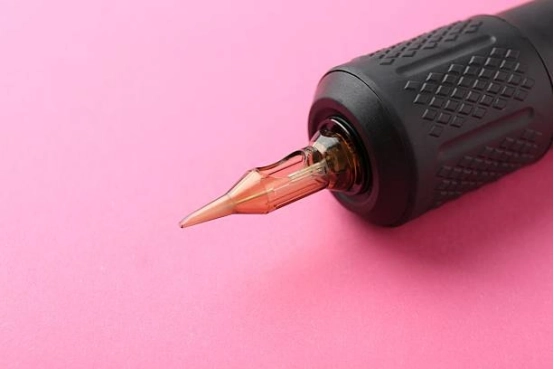
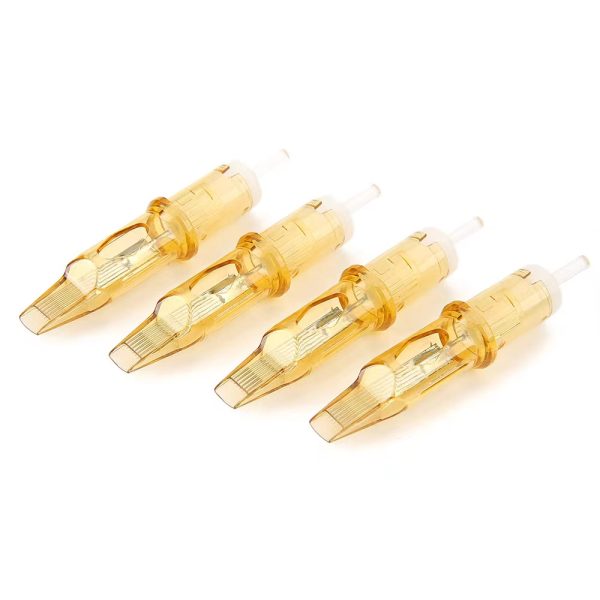
Look at the points across the front of the grouping. A straight magnum has a relatively straight working edge. With a curved mag, you can trace a shallow arc from one side to the other: shorter outer points, longer points toward the middle.
"Curved" can be a slightly misleading word until you see that profile. It describes the outline across the tips. The pins themselves aren’t bent into hooks.
That shorter outer edge is why artists often reach for curved mags when a shadow needs to taper away without a strong border. A straight mag gives a more even front edge across its width. You may prefer that reference when filling toward an existing outline.
There is a naming trap here: a straight magnum and a flat needle are different groupings.
|
Grouping |
Arrangement |
Front Edge |
|---|---|---|
|
Straight magnum |
Two rows of pins |
Relatively straight |
|
Curved magnum |
Two rows of pins |
Rounded across the tips |
|
Flat needle |
One row of pins |
Straight |
When someone says "flat mag," check which grouping they mean. Otherwise two artists can discuss the same label while picturing different needles.
What Do RM, M1, and Needle Count Tell You?
RM commonly means round magnum. CM and soft-edge magnum are other names used for the curved family. M1 usually identifies a standard weaved magnum. Check the actual tip profile when moving between ranges; the abbreviation does not give you an exact curve radius.
Keep the count separate, too. A 15-pin magnum contains fifteen individual needles. It is not 15 mm wide.
You can compare RM and M1 groupings within our GT-R cartridges. For diameter, #10 means a 0.30 mm pin; #12 means 0.35 mm. Put several of those pins together and the complete assembly is wider, of course. Neither number gives you that total width.
This matters in a comparison. Swap a 0.30 mm curved mag for a 0.35 mm straight mag and you have changed two things already. Any difference in the mark cannot be put down to curvature alone. Match the taper as well before deciding which edge you prefer.
Which Magnum Works Better for Shading and Color Packing?
Go back to the drawing and pick one area. Where does the color stop? That is the part of this decision I’d settle before worrying about which mag suits the style.
For a Fade That Should Disappear
At the pale end of a petal, an unwanted stripe can read as a crease. You might spend more time correcting that little boundary than filling the darker area beside it.
A curved mag is a sensible choice here because the shorter outer points can help soften the boundary. Wipe the ink away and look at the lightest part. If you can identify every movement by its edge, the fade still needs work.
Before swapping needles again, check where your hand slows down. A curved profile can still leave a dark patch if you keep stopping in the same place.
For a Filled Area with a Defined Edge
A straight mag is worth trying when you want a broad working edge beside a clear outline. On a filled leaf, for example, you may find that shape easier to place as you approach the boundary.
Curved mags can fill that leaf too. If you’re comfortable approaching the outline with one and the fill is even, keep it. We wouldn’t change a working combination simply because someone calls straight mags "packing needles."
How Can You Compare Magnum Needles in the Studio?
Set aside a piece of practice skin. A small repeated exercise makes differences easier to spot than changing cartridges halfway through an unrelated design.
Match the Specifications
Choose the same pin count and diameter in both profiles. Match taper wherever possible. An uncertain cartridge and machine fit needs sorting out before the comparison has much value.
Both samples need the same ink and machine setup on the same practice material. If you adjust the setup for one sample, write that down beside its result.
Look at the Mark After Wiping
A useful exercise is a narrow fade, perhaps 30 mm long and 10 mm wide, with a 20 mm square beside it for filling. Give each cartridge three attempts at both shapes.
Check the light end of the fade for a sudden edge. In the square, look for pale gaps after wiping away surface ink. Note where you needed another pass.
One good swatch can be luck. Three similar results tell you more about control. A photograph helps, provided you haven’t moved one sample into better light. Keep its cartridge label in the frame. Use practice skin to compare handling; assess healed results separately in your professional work.
Which Magnum Configuration Should You Try Next?
Take a size you already handle well and compare the other edge profile in a similar specification. Bring the swatches into the conversation with your studio colleagues. "Softer" is much easier to discuss when everyone can see the edge you’re talking about.
Still unsure what an RM or M1 code means for your choice? Check the configuration with us using the cartridge code and the mark you want to make. A soft petal shadow gives us more to work with than "a better shading needle."
FAQ
Is a Round Magnum the Same As a Curved Magnum?
Usually, yes. The word "round" refers to the front profile. Be careful with RS, though: that’s a round shader with pins arranged in a circle. An RM still has the broad magnum arrangement, even if both packets happen to say "round."
Can You Pack Solid Color with a Curved Magnum?
Yes, and you don’t need to abandon a curved mag that already gives you good fills. Check the square in your practice comparison. Pale gaps deserve a closer look at how you’re covering the area, including how your movements overlap.
Does a Larger Magnum Always Cover More Area?
Often, within the same range. But pin spacing and diameter affect width too. Compare the actual grouping when changing brands. The bigger number on the packet won’t tell you how easily that mag will fit into a narrow part of your design.
Are Curved Magnums Always Gentler on Skin?
No. A rounded edge does not establish how skin will respond. Working depth and repeated passes still matter, along with the artist’s control. Choose curvature for the mark it helps you make; do not treat the label as permission to keep working an area.