Custom tattoo machines are often treated as a branding exercise: add a logo, change the box, choose a color, done. That is the simplest version of customization, but it barely touches what can actually be changed.
For a tattoo brand, distributor, or equipment company building a private-label line, the more useful questions are technical. What stroke range does the target artist need? How heavy should the pen feel after a three-hour session? Does the battery need to survive a full working day? Should the product sit at an entry-level price or compete with professional flagship machines?
A capable OEM tattoo machine manufacturer should be able to work through those decisions before mass production starts.
1. Branding and Logo Customization
Branding is usually the easiest place to start, especially when a company wants to test a product without developing an entirely new machine.
Logo customization sounds simple, but placement and manufacturing method matter more than expected.
Logo Placement
A logo can be placed on the machine body, grip, battery housing, carrying case, retail box, or several of these areas at once.
The machine body usually deserves the most attention. A logo that looks balanced on a drawing can feel oversized once applied to a 30 mm cylindrical housing. Small details may disappear after engraving.
For private label tattoo machines, it is worth checking a physical sample rather than approving placement from a digital rendering alone.
Logo Application Methods
Laser engraving is common on metal housings because it is durable and gives a clean, industrial finish. Printing allows more freedom with color and complex graphics. Labels can work for packaging and accessories where direct marking is unnecessary.
The right method depends on material, surface treatment, order quantity, and the desired retail position. A premium wireless pen with a poorly printed logo immediately feels cheaper than it should.
2. Custom Colors, Finishes, and Machine Appearance
Once the basic branding is fixed, appearance becomes the next obvious area. This is where two machines using a similar internal platform can look completely different on a retail shelf.
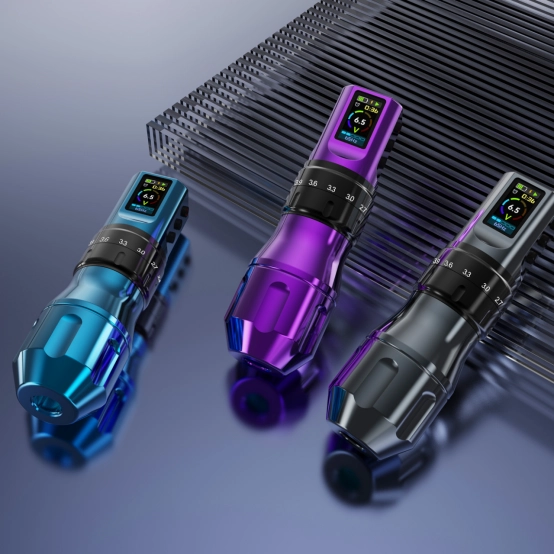
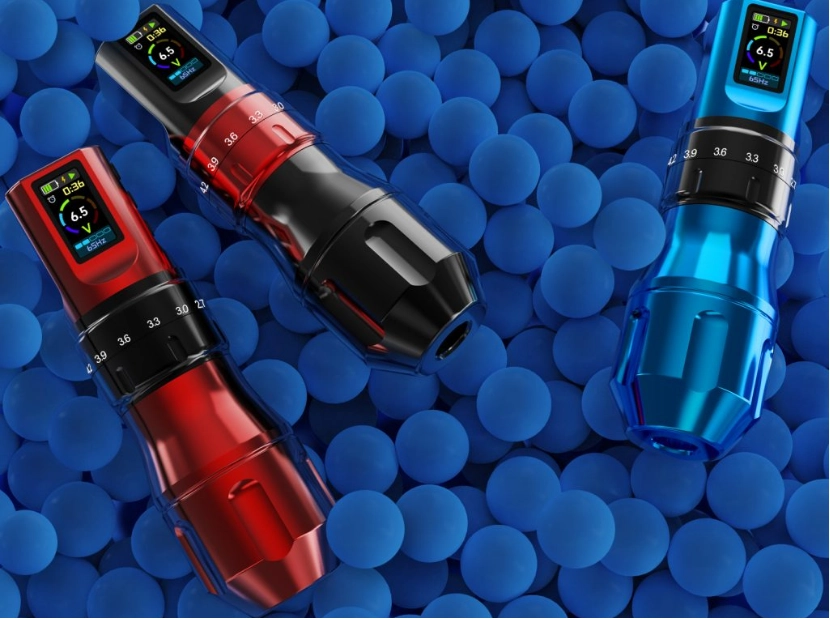
A custom wireless tattoo machine may use different body colors, grip colors, surface textures, metallic finishes, matte treatments, or two-tone combinations.
Color matching needs restraint. A bright finish can look impressive in a 3D render and less convincing after anodizing. Dark grey, black, muted metallic tones, and controlled accent colors tend to age better in professional equipment.
Some brands also build several SKUs around one platform. Same motor, same stroke, different exterior. That reduces development complexity while still giving distributors a broader collection to sell.
3. Tattoo Machine Specifications and Performance
Appearance gets attention. Performance keeps the product in the market.
For OEM tattoo machines, specification work should start from the type of artist the product is being built for. A machine intended for fine-line work does not need exactly the same setup as a hard-hitting all-rounder.
Stroke Length
Stroke length affects how the machine feels and how it delivers the needle.
Fixed-stroke machines keep the mechanism simple and predictable. Adjustable-stroke designs give artists more flexibility, but the mechanism must remain stable after repeated adjustment.
A 3.5 mm setup is often treated as a versatile middle ground. Longer strokes may suit stronger lining and packing applications, while shorter settings can feel softer for certain shading work. The correct choice depends on the product concept, not on choosing the largest number for a specification sheet.
Motor Configuration
Motor selection influences speed, torque, vibration, heat, noise, and long-session consistency.
A high-speed motor is not automatically better. If the torque curve does not match the drive system, the machine may sound powerful while feeling unstable under load.
During OEM development, motor behavior should be tested with the actual cartridge and operating voltage expected in use. Bench specifications alone rarely tell the full story.
Voltage and Operating Characteristics
Voltage range, starting behavior, speed adjustment, protection logic, and power delivery can also be configured around the machine platform.
This part deserves practical testing. One prototype may run smoothly at 7 V but feel noticeably rough at the lower end of its advertised range. That is the kind of issue worth finding before several thousand units are packed.
4. Battery and Wireless System Customization
Wireless machines add another layer of engineering because the battery becomes part of the user experience, not just a power source.
Battery capacity, housing design, charging interface, display style, button layout, replaceable battery options, and power control can all be discussed during a custom wireless tattoo machine project.
Large battery capacity looks good in marketing material, but weight matters. A heavy battery positioned too high on the machine changes the balance in the hand.
For many professional users, a slightly smaller battery with sensible weight distribution is preferable to chasing maximum advertised runtime. Charging speed and battery consistency across production batches deserve the same attention.
5. Grip, Size, Weight, and Ergonomic Design
Machine dimensions are often adjusted late in development. That is risky.
Grip diameter, total length, body shape, weight distribution, and surface texture affect how a tattoo pen feels after extended use. Two machines weighing exactly the same can feel very different if one carries most of its mass near the battery.
A distributor targeting artists who work long black-and-grey sessions may prefer a balanced, moderate-weight body over a compact but top-heavy design.
Prototype testing helps here. Pick up the machine, rotate it, run it for an hour. Small discomfort becomes obvious quickly.
6. Custom Packaging and Accessories
The product does not stop at the machine body. For private label tattoo machine programs, packaging is part of the customer experience and part of the supply chain.
Brands can customize retail boxes, carrying cases, instruction manuals, charging cables, spare batteries, inserts, stickers, barcode labels, and bundled accessories.
Packaging also needs to survive freight. A presentation box that looks excellent in a showroom but allows the machine to move during international shipping is badly designed.
For e-commerce sellers and distributors, SKU labels, barcode positions, manual language, and carton markings should be agreed before production. These details are boring until they are wrong.
7. From Existing Models to Full OEM/ODM Development
Not every brand needs a completely new machine. In many cases, using an existing platform is the faster and more economical route.
Level 1 — Private Label
Private label projects normally keep the existing machine structure and specifications while changing elements such as the logo, color, packaging, and accessories.
This approach suits brands that want faster market entry with less tooling and development work.
Level 2 — Modified OEM Product
A modified OEM project goes deeper. The existing platform may remain, but stroke options, battery configuration, surface treatment, controls, accessories, or external components can be changed.
This is often a practical middle ground. More differentiation, without rebuilding everything.
Level 3 — ODM / New Product Development
ODM development starts closer to a product concept than an existing SKU.
It may involve new exterior design, internal structure, control systems, tooling, prototypes, performance testing, and several engineering revisions.
This route makes sense when the product needs a clear technical or visual identity that cannot be achieved by modifying a standard machine.
8. What Should You Prepare Before Starting a Custom Tattoo Machine Project?
A custom project moves faster when the buyer arrives with more than a logo file.
Useful information includes the target market, preferred machine type, expected stroke or performance range, appearance requirements, packaging concept, estimated quantity, target price level, and expected launch schedule.
Reference products also help. Not for copying, but for explaining weight, grip size, button feel, display style, or overall positioning.
MOQ, tooling cost, sample cost, and production lead time depend heavily on how much is being changed. A logo project and a new housing design should not be quoted as if they were the same job.
Why Work With INKONE for Custom Tattoo Machines?
INKONE provides professional tattoo equipment and supplies for B2B customers, including tattoo brands, wholesalers, distributors, and sourcing companies. Its OEM/ODM service can support different levels of customization, from private-label branding and packaging to product specification changes and broader product development. Buyers can also source machines, needles, power products, printers, consumables, and related studio supplies through one supplier.
Looking to develop custom tattoo machines for your brand?
Contact INKONE to discuss product specifications, branding requirements, samples, MOQ, packaging, and OEM/ODM options.
FAQ
Q: Can I put my own logo on a tattoo machine?
Yes. Depending on the machine material and design, logos can usually be applied through laser engraving, printing, customized labels, or branded packaging.
Q: What is the MOQ for custom tattoo machines?
MOQ depends on the machine model and level of customization. Logo and packaging changes generally require less development than custom colors, components, specifications, tooling, or structural changes. The manufacturer should evaluate the project before confirming an order quantity.
Q: What is the difference between private label and OEM tattoo machines?
Private label tattoo machines normally use an existing product with customized branding, colors, or packaging. OEM projects can involve deeper changes to specifications, components, battery systems, appearance, accessories, and performance. ODM development goes further and may include new product design and tooling.