The tattoo industry has seen a massive shift toward hyper realism and micro-sized art, which has fundamentally changed how we look at needle gauges. A bugpin isn’t just a “thin needle”; it’s a specific engineering choice for artists who find standard #12 needles too aggressive for delicate work.
What Distinguishes a Bugpin from a Standard Needle?
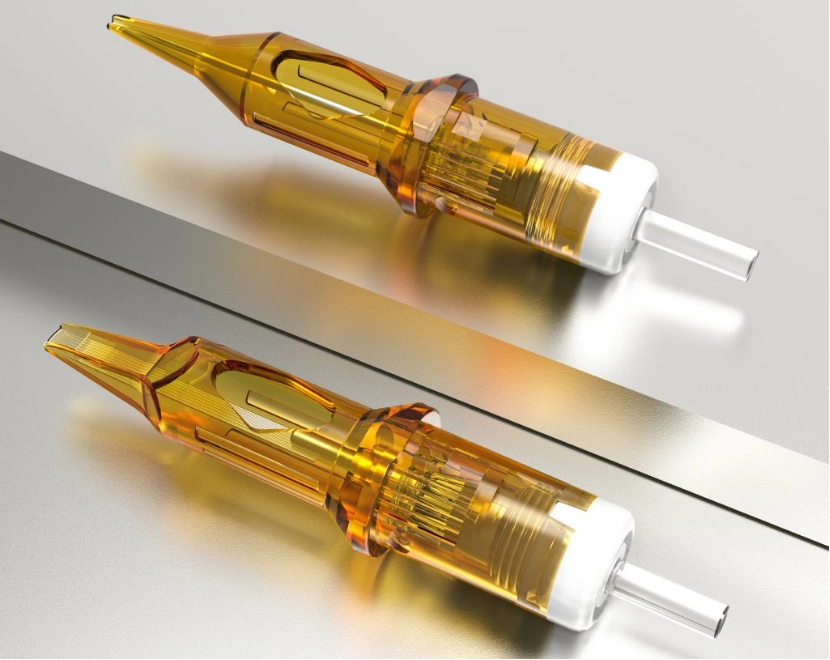
The primary difference lies in the diameter of the individual pins. Bugpin needles feature a significantly narrower diameter, typically ranging from 0.20mm to 0.25mm (#06 or #08 gauge).
When you hold a standard #12 (0.35mm) next to a #08 bugpin, the difference is visually obvious. The physical construction allows for more needles to be grouped within the same space as a standard configuration. This means you can have a 7 round liner bugpin that occupies the same footprint as a standard 3 or 5 round liner. Because the individual points are so much finer, the reduced surface area per needle point results in less skin trauma and a more delicate puncture. It’s like the difference between a blunt nail and a sewing pin; the latter slides in with almost no resistance.
Technical Advantages for High Detail Artistry
Using a bugpin tattoo needle changes the texture of the ink deposited into the dermis. Since the points are smaller, the “pixel” size of the tattoo is reduced.
Narrower diameters create smaller “dots” of ink, enabling smoother transitions in black and grey realism. If you’re doing a portrait, you don’t want the forehead shading to look grainy. The tighter grouping of bugpins allows for precision that standard #12 needles cannot replicate in micro scale work. There is also a fluid dynamics benefit here. Increased capillary action within the tighter grouping helps in consistent ink flow for intricate linework. The ink stays trapped between the pins more effectively, leading to longer pulls without the needle running dry halfway through a line.
When Should a Professional Switch to Bugpins?
Deciding to switch usually happens when an artist hits a wall with standard gauges—specifically when trying to achieve soft, “airbrushed” effects.
Achieving Seamless Gradients in Realism
Bugpins are the preferred choice for soft shading where visible “pepper” texture needs to be minimized. In realism, the goal is often to hide the fact that a needle was used at all. They allow for building up layers of grey wash slowly, preventing the “over saturated” look in delicate portraits. It gives the artist a safety net. You can pass over the same area multiple times to darken a value without the skin becoming chewed up or overworked.
Precision in Micro-Tattooing and Fine Line Work
For the rising trend of “fineline” tattoos, bugpins are almost mandatory. They are ideal for scripts, geometric patterns, and ultra fine lines that require a steady, thin deposit of pigment. When working on a tiny script behind an ear, a standard #12 might spread too much over time. Bugpins provide the control necessary for tight corners and complex textures in illustrative styles, ensuring that the lines remain crisp as the tattoo heals.
Does the Taper Length Matter When Using Bugpins?
Taper and diameter work in tandem to determine how the needle interacts with the skin. A bugpin with a short taper is a rare beast and usually counterproductive.
Long tapers combined with bugpin diameters offer the least resistance during skin penetration. This is the “sweet spot” for most realism artists. However, medium tapers are often utilized with bugpin groupings for color packing in small, concentrated areas. The choice of taper affects how much ink is deposited per hit, balancing speed with detail. A longer taper generally deposits less ink per hit but does so very cleanly, while a shorter taper opens a larger hole, allowing more pigment to enter at the cost of more trauma.
Practical Considerations for the Professional Studio
Transitioning to bugpins requires more than just swapping the cartridge; you have to rethink your tattoo machine‘s physics.
Adjusting Your Machine Speed and Hand Motion
Because bugpins penetrate the skin more easily, artists often need to adjust their voltage to prevent over working the tissue. If you run your machine at the same high voltage used for standard 12s, those tiny bugpins can act like a scalpel. Hand speed must be synchronized with the smaller puncture rate to ensure solid saturation without scarring. I’ve noticed that slowing down the hand slightly while dropping the voltage by 0.5V to 1.0V often yields the best results.
Compatibility with Pigment Thickness
Not all inks play nice with tight groupings. Thinner pigments and grey washes flow more efficiently through tight bugpin configurations. If you’re using a very thick, high pigment load “triple black,” you might run into issues. High viscosity inks may require a slightly larger gauge or a specific needle texture to avoid clogging the tip. Sometimes, adding a drop of distilled water or shading solution to the cap is enough to get the flow right.
Why Quality Consistency is Critical for B2B Sourcing
When buying in bulk for a studio, the margin for error with bugpins is incredibly slim. A tiny defect in a 0.25mm needle is much more impactful than a defect in a 0.35mm one.
Inconsistent needle diameters in bulk orders can ruin a professional’s workflow and reputation. If one cartridge in a box is a #08 and the next is a #10, the artist loses their “feel” for the depth. High grade 316L stainless steel ensures that the fine tips of bugpins do not hook or dull prematurely during long sessions. There is nothing worse than a needle tip curling into a “hook” inside the skin.
Looking for a dependable tattoo needle supplier? Contact INKONE today to discuss wholesale tattoo needle options, custom packaging, and bulk supply solutions for your business.
FAQ
Q: Can I use bugpins for bold traditional work?
A: Generally, no. Bugpins are designed for detail and soft transitions. For bold, “traditional” lines, a standard #12 or even a #14 gauge is better suited to move the necessary amount of ink.
Q: Do bugpins hurt more or less for the client?
A: Most clients report less “sharp” pain due to the smaller puncture size, but because bugpins are often used for multiple passes in realism, the area can feel more “raw” toward the end of the session.
Q: Are bugpin needles more expensive?
A: Often, yes. The manufacturing process for finer gauge steel and the precision required for tighter soldering usually commands a slightly higher price point in the B2B market.